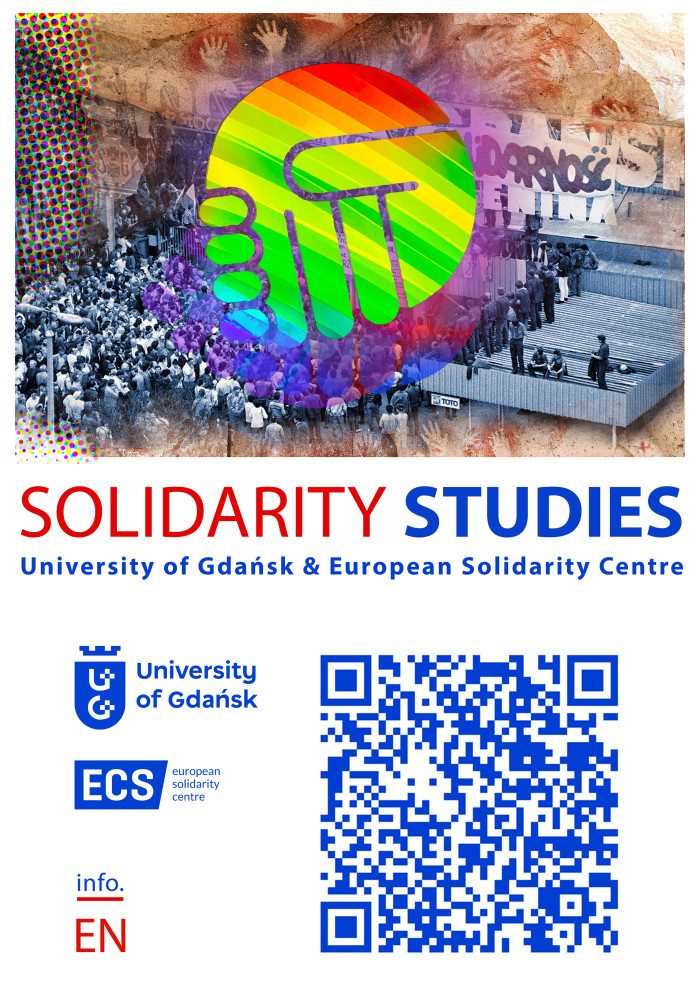
Solidarity Studies - New Degree Course at Faculty of Social Sciences of University of Gdańsk


1,5-year Master's program in English (90 ECTS)
More information: https://old-en.ug.edu.pl/study/educational_offer/20262027/solidarity_studies-stacjonarne-ii_stopnia
What for and why in Gdańsk?
The UG is particularly well-suited to studying solidarity, as it highlights the value of solidarity and the resulting visions of a deeply democratic community, concerned with the public good and not subordinating this good to particular interests. Today, in the face of strong anti-democratic tendencies, wars, and global conflicts related to the unfolding climate catastrophe, the importance of such a community is growing. The grassroots social movement "Solidarity" was born in Gdańsk, and in August 1980, a peaceful revolution took place in this city that overthrew the communist regime. The European Solidarity Centre, commemorating this, is a co-running partner of Solidarity Studies, and students have part of their classes there - with a permanent exhibition "Roads to Freedom", a thematic library, and numerous artistic and social events. These unique studies are for those who desire the knowledge, skills, and competencies that will allow them to not only adapt to today's rapid social, economic, climatic, and other changes, but also overcome them as crises. Solidarity Studies teach them how to create and implement solutions to the problems these changes create. The key is solidarity, which, as a practiced value, responds to the needs of contemporary reality.
Programme highlights
1/ modular structure of 3-semester MA studies
The curriculum consists of six modules, focusing on key issues in Solidarity Studies and presenting - like a hologram - the profound meaning of this concept: 1/Solidarity in General, 2/Solidarity Economy, 3/Diverse Solidarity, 4/Solidarity, Now!, 5/Solidarity Society, 6/Solidarity Politics.
2/ flexible learning paths and the opportunity to receive micro-credentials for each module.
The importance of micro-credentials is borne out by the practice of offering all Solidarity Studies modules as micro-qualifications, giving students the option to complete their studies at any time. To facilitate this, the modules are organized into blocks.
The offer of the "Fahrenheit Universities" association, of which UG is a member, with accredited specialisations and fields of study, providing micro-credentials and other forms of flexibility in learning paths, greatly expands the opportunities for students within Solidarity Studies.
3/ Guest Lectures and Study & Research Projects as a guarantee of the current educational content in a rapidly changing world.
Each module includes guest lectures, scheduled to be given by distinguished scholars with global achievements and experts in solidarity in its various aspects and contemporary contexts.
Study & Research Projects, which appear in each module, allow students to conduct research in the current reality and confront their theoretical knowledge with socio-political, climatic, etc. realities. All completed research projects contribute to a Master's Thesis, defended at the end of the final semester.
Who is the MA in Solidarity Studies for?
BA/first-degree graduates (or equivalent) from Poland and abroad who want to study in an English-taught program and develop as professionals in a rapidly changing world.
Socially engaged people: change leaders, activists, and those seeking evidence-based tools for action in today’s “crisis realities”.
Future or current professionals working (or planning to work) in public institutions (government/local government), NGOs, education and social support institutions, social and solidarity economy, and in companies delivering social missions/CSR.
Educators and managers (teachers, educators, advisors/mentors, directors/leaders) who want to strengthen their impact in diverse communities and organizations.
What you gain
Knowledge
- Solidarity as a key concept and practice in contemporary societies (social, economic, political and cultural dimensions).
- How major transformations and crises (incl. democratic backsliding, inequality, climate-related challenges) reshape communities and institutions.
- Core approaches to social research and evidence-based problem diagnosis (including participatory and innovative methods).
Skills
- Critical analysis and synthesis of complex social problems; turning evidence into well-grounded conclusions.
- Designing and conducting social research (qualitative/quantitative/participatory) and presenting results for different audiences.
- Planning and delivering team-based projects and social innovations in diverse, often international settings.
Social competences
- Ethical responsibility, accountability and orientation towards the common good.
- Openness to diversity and readiness to work for inclusion and social cohesion.
- Collaboration and leadership in interdisciplinary and multicultural environments.
Job prospects
Masters in Solidarity Studies will be animators and leaders of change towards practicing solidarity for community life in local and supra-local, institutional, formal and informal social environments and ecosystems.
In a more specific sense, graduates will be prepared to work in various companies, enterprises, non-governmental organizations, and public institutions, both in the public sector (e.g., offices, schools) and beyond – wherever combining knowledge and skills in the public sphere is necessary – in social, socio-educational, and political activities, including those aimed at revitalizing and "concreting" concern for the common world, shaping community forms of life based on democratic values and human rights, and promoting the inclusion of individuals and groups at risk of exclusion and marginalization. Graduates of Solidarity Studies acquire the skills necessary to research and develop a multidimensional understanding of solidarity, which is currently essential in various spheres of public life, including, among others, the social sphere. These include establishing a non-governmental organization or a social economy entity, as well as working in public organizations (central or local government), non-governmental organizations, and enterprises implementing various types of changes that prioritize the common good, achieved through the practice of solidarity.
Studies in this field will provide the opportunity to expand knowledge about the current state of social life (including political and ecological aspects), which allows for the achievement of social goals while simultaneously caring for the common good and the world as a more-than-human community. Solidarity Studies will also introduce future professionals in various fields (in line with the areas of prior education – bachelor's degree) as well as leaders and social activists to operate with full awareness of the importance and significance of the value of solidarity in contemporary reality. These studies will also enrich students with essential skills for planning and implementing changes related to living in solidarity – in organizations and, more broadly, in society.
Solidarity Studies will also help graduates find their place in the realities of global centres involved in solidarity studies, for example thanks to the participation (in Solidarity Studies’ implementation) of scholars from the network of European solidarity researchers.
Contact us for more detailed information about the study program, admission requirements, and recruitment: https://en.ug.edu.pl/incoming-students/candidates/bachelors-and-masters-courses/contact-us